

RAVEL at NVIDIA GTC 2026: AMPHIX, AI Factories, and the Future of Enterprise AI Infrastructure
NVIDIA GTC 2026 set the tone for where AI is going.
With 25,000 attendees on the ground and 300,000 tuning in virtually, it was the biggest stage in AI. The takeaway was clear. The companies that win will not be the ones with the most GPUs, but the ones who can run them at scale.
That's exactly why RAVEL came to GTC — not just to attend, but to show what AI infrastructure done right actually looks like.

The RAVEL team at GTC 2026, showcasing AMPHIX — Infrastructure, Orchestrated — built with partners including Strata Expanse and Available Infrastructure.
The Problem Nobody Wants to Talk About
While much of the conversation at GTC focused on AI factories, the real challenge is the infrastructure gap. This gap spans three critical areas.
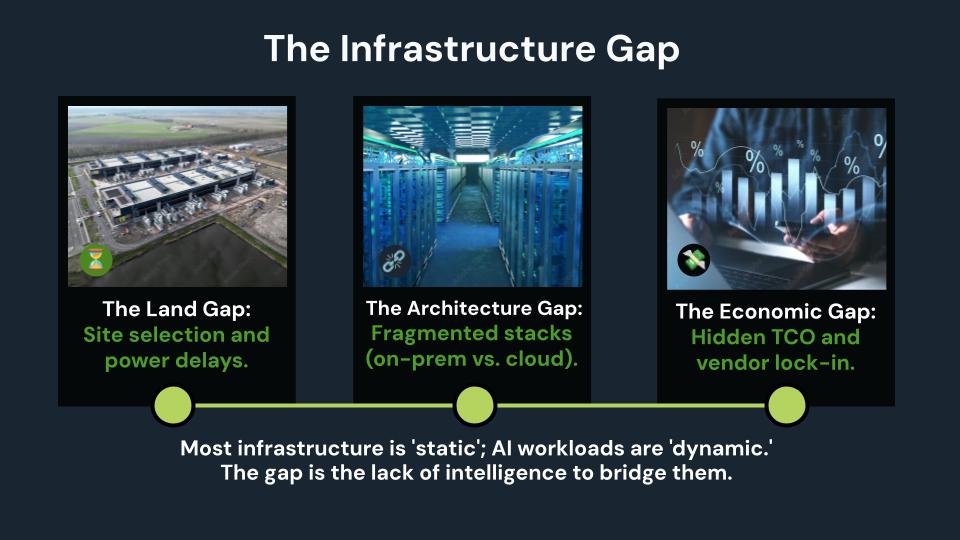
The three core gaps slowing AI at scale: land, architecture, and economics — where infrastructure fails to keep up with dynamic workloads.
The Land Gap. Access to sites that can support AI at scale is limited, especially when sustainable power and the right energy profile are required.
The Architecture Gap. Cloud, on-prem, and hybrid environments were not designed to operate as a unified system, creating fragmentation and operational complexity.
The Economic Gap. Without full visibility across the stack, organizations cannot accurately understand or control the cost of running AI.
The result? Idle GPUs. Infrastructure that looks fully booked on paper but is deeply underutilized in reality — due to storage throughput issues, network congestion, scheduling conflicts, or power constraints that nobody even knew existed.
“The most important thing is no longer how many GPUs you have — it's how efficiently and effectively you can optimize every single piece of your technology stack.”
— Philippa Carroll, CPO, RAVEL
Introducing AMPHIX: AI Infrastructure Built for the Real World
AMPHIX was RAVEL’s key announcement at GTC 2026. Developed in collaboration with Strata Expanse and Available Infrastructure, the Amphix AI Infrastructure Platform is designed to close the infrastructure gap that continues to slow enterprise AI adoption. The platform brings together four integrated layers that move organizations from site-ready capacity to production AI with greater speed and certainty.
Think of it as a four-layer cake, each one engineered to work seamlessly with the next.
The Site Layer. Infrastructure-ready locations with sustainable power, advanced cooling, and secure connectivity, scaling to 30 sites and expanding to 100 cities.
The Technology Layer. A certified stack across storage, compute, and networking, built to perform at scale.
The Orchestration Layer. AA unified control plane through RAVEL Orchestrate AI, enabling real-time scheduling, visibility, and power-aware control.
The Deployment Layer. A AI Centers of Excellence that act as a proving ground for organizations to validate, set governance, and accelerate production AI.
RAVEL + DDN: When Orchestration Meets Data Performance
Intelligent orchestration is only half the equation. At the DDN booth on the show floor, the message was clear: if data cannot reach the GPUs fast enough, performance breaks down.
For enterprise workloads such as RAG and autonomous systems, data throughput directly impacts user experience, reliability, and outcomes.
This is why the partnership between RAVEL and DDN is foundational. DDN delivers high-throughput data pipelines, while RAVEL ensures resources are orchestrated efficiently across the stack. Together, they enable infrastructure that operates at full capacity in real-world environments.
This collaboration is realized in a new validated solution based on the DDN Enterprise AI HyperPOD™ architecture, built on Supermicro, accelerated by NVIDIA AI computing and software platforms, and optimized by RAVEL’s Orchestrate AI.
- Supermicro high-performance GPU infrastructure
- DDN Infinia data platform
- NVIDIA AI Enterprise software stack
- RAVEL Orchestrate AI as the control plane
The result is measurable: higher GPU utilization, lower power cost, and infrastructure that performs at scale from day one. It is not available for proof of concept (PoC) in AMPHIX Centers of Excellence.
RAVEL Orchestrate AI: The Intelligent Control Plane
Within AMPHIX, RAVEL Orchestrate AI serves as the control plane that executes workloads across the full infrastructure stack, from power and compute to storage and networking.
It operates across bare metal, cloud, and hybrid environments, dynamically scheduling workloads based on real-time utilization, performance requirements, site availability, and governance priorities.
It also enables GPU-as-a-Service delivery, allowing organizations to provision GPU resources on demand with full visibility into usage, cost, and performance. At GTC, this model was a consistent theme in conversations with neo-cloud providers and enterprise partners looking to scale AI infrastructure more efficiently.
From the Suite to the Show Floor
RAVEL engaged with customers and partners across GTC, from private meetings at the Westin to discussions on the show floor.
In the suite, conversations moved quickly from presentations to deployment planning with enterprise teams and partners.
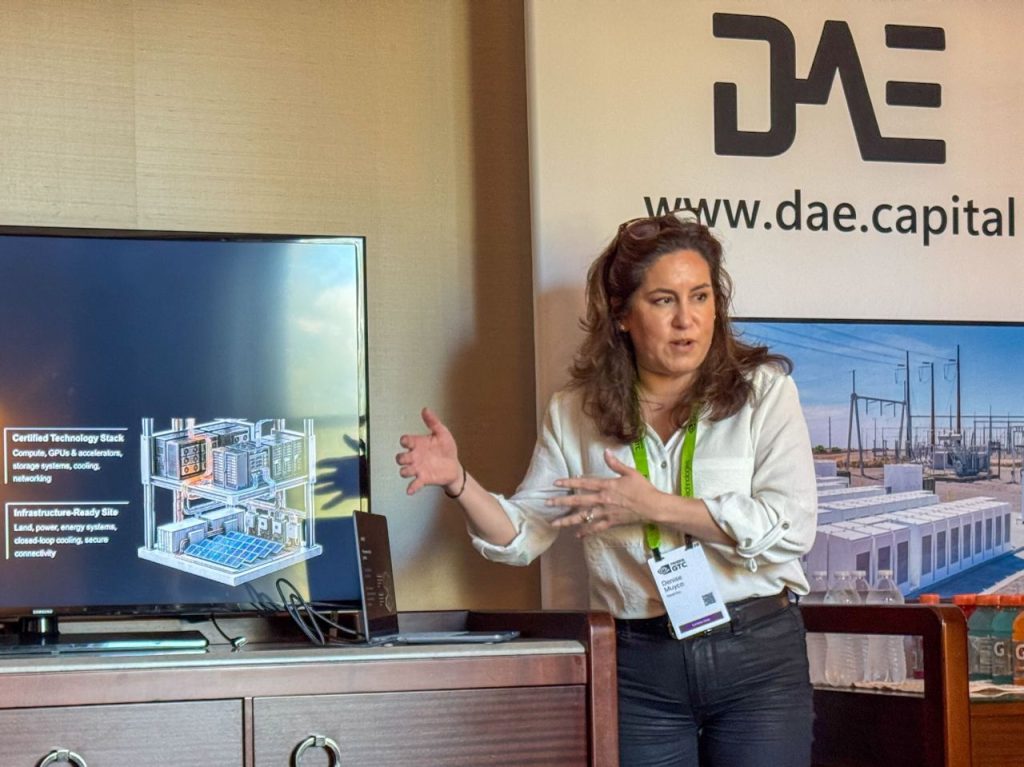
Denise Muyco, CEO of RAVEL, walking partners and customers through the AMPHIX infrastructure model during a private session at GTC 2026.
Beyond the floor, conversations continued across dinners, partner meetings, and events, where relationships deepened and ideas moved closer to execution.
The Takeaway
GTC 2026 confirmed a clear shift.
The bottleneck in enterprise AI is no longer the model, or number of GPUs you have.
It is the ability to efficiently and effectively orchestrate and manage workloads across infrastructure, spanning land, power, and technology, while getting full visibility and control over economics.
RAVEL, alongside partners including Strata Expanse, Available Infrastructure, DDN, Supermicro, and NVIDIA, presented working solutions. Not concepts or roadmaps, but validated systems designed to move enterprises from proof of concept (PoC) to production AI at scale.
AI factories are no longer theoretical. AMPHIX is designed to make them operational.
Ready to explore what AMPHIX can do for your organization?
Start your proof of concept (PoC) today at amphixplatform.com or visit ravelinc.com/amphix-poc/ to learn more.