

RAVEL at SIGGRAPH 2026: Back to Our Roots, Powering Generative AI for Media & Entertainment
SIGGRAPH 2026 brought the graphics world back to Los Angeles.
For three days at the Los Angeles Convention Center, the premier conference on computer graphics and interactive techniques put one theme front and center: AI is no longer a side conversation in media and entertainment. It is a key part of the production pipeline.
For RAVEL, SIGGRAPH was more than a conference. It was a homecoming.
RAVEL started by orchestrating compute and render jobs for some of the most complex Hollywood productions. At SIGGRAPH 2026, we returned to our roots in Media & Entertainment with a working answer to the question every studio is asking: how do we scale generative AI production without buying a mountain of new hardware?
The Problem Studios Know Too Well
Talk to any studio technology leader and you'll hear the same challenges:
Artists waiting on AI jobs, workflows that are difficult to operationalize, AI tools that are complex to deploy and manage, rising cloud costs, and growing concerns about protecting proprietary IP.
The result is a strange paradox. Studios often own powerful hardware, yet artists can access it when using AI powered workflows.
Our message at SIGGRAPH was simple: spend more time creating. Less time waiting for compute.
Post Perspective: SIGGRAPH 2026: Ravel's Philippa Carroll
The Demo: ComfyUI Meets Centralized GPU Power
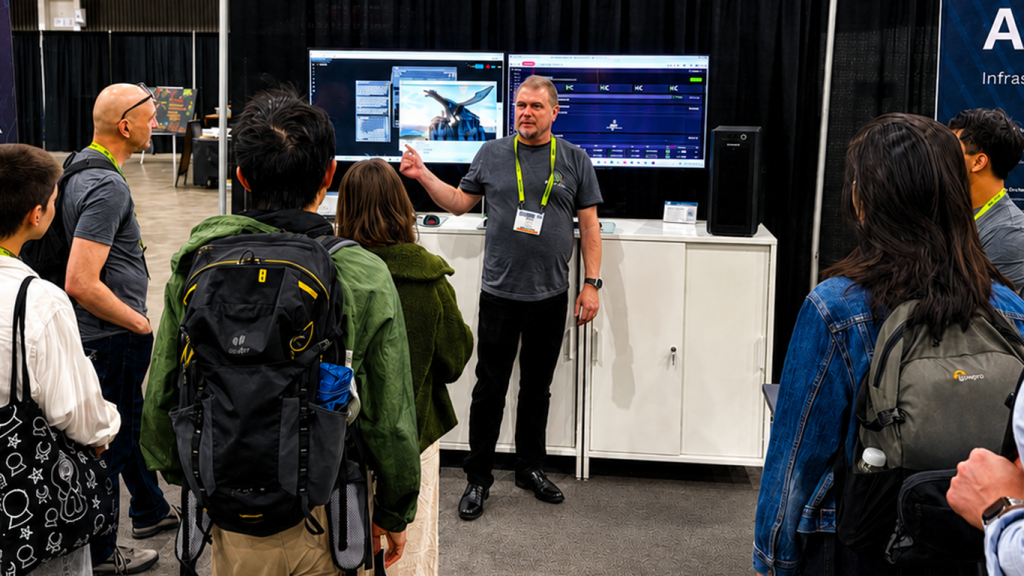
The heart of Booth #857 was a live demonstration built on three Supermicro high-performance workstations, powered by NVIDIA RTX GPUs and Intel CPUs.
Here is how it worked.
Step 1: The familiar starting point. An artist running ComfyUI with an LTX-2.3 text-to-video workflow. Uses the standard ComfyUI workflow of hitting the run button to generate content locally for experimentation and quick iteration of low res outputs.
Step 2: The RAVEL difference. With the RAVEL plugin for ComfyUI, the artist bypasses local compute for heavier jobs that require more GPU horsepower. The same job, upscaled and AI-enhanced using Topaz goes to a centralized compute queue managed by RAVEL Orchestrate AI.
Step 3: The payoff. The centralized job delivers the upscaled and enhanced video in less time than the local render. Outputs land on a shared file storage the artist can access right from their workstation. No manual handoffs. No lost time waiting for renders. Leaving the artist's local machine free for creative work the entire time.
RAVEL Booth SIGGRAPH 2026: Workflow demo with Chief Product Officer, Philippa Carroll
RAVEL Orchestrate AI and the RAVEL ComfyUI plugin act just like a render manager for AI: Intelligent management of how jobs run on your AI renderfarm and an easy way for artists to submit jobs without leaving their creative workflow.
A few details that resonated with attendees:
- The ComfyUI plugin supports any models and LoRAs already in an artist's workflow
- Teams not using ComfyUI can get plugins for other applications, or build their own with the RAVEL SDK
- Centralized compute resources are available today through the AMPHIX AI Centers of Excellence, with flexible, on-demand pricing
Take Your Own Workloads for a Test Drive
One of the most common questions we heard at SIGGRAPH was,
'Can we try this with our own workflows?'
The answer is yes.
Through the AMPHIX AI Centers of Excellence (COEs), companies can access production-ready GPU infrastructure to run, test, benchmark, and validate their own AI pipelines—without the time, cost, or complexity of building dedicated infrastructure first.
Whether you're exploring generative AI for content creation, evaluating centralized AI rendering, or looking to scale beyond individual workstations, the COEs provide a practical environment to see how your workloads perform in a real-world production setting.
For companies we met at SIGGRAPH, this is the natural next step. Bring us your ComfyUI workflows, custom models, LoRAs, or other AI applications, and we'll help you run them on centralized GPU infrastructure managed by RAVEL Orchestrate AI. Together, we can benchmark performance, optimize resource utilization, and demonstrate how intelligent orchestration can reduce render times, improve GPU efficiency, and keep artists creating instead of waiting.
The COEs are designed to remove barriers to adoption. There's no large upfront infrastructure investment, no lengthy deployment cycle, and no need to rearchitect your environment before you can evaluate the technology. Simply bring your workloads, access GPU capacity on demand, and see the results for yourself.
The Takeaway
SIGGRAPH 2026 confirmed what we came to prove.
Generative AI is now core to media and entertainment production. And the bottleneck is not creativity or models. It is infrastructure that keeps artists working.
RAVEL Orchestrate AI, the RAVEL ComfyUI plugin, and the AMPHIX Centers of Excellence, together with partners Strata Expanse and Supermicro, showed a working path forward. Not slides. Working solutions, live on the show floor.
Keep the Conversation Going
If you visited us at Booth #857, thank you. If you missed us, the demo is still running and the offer still stands.
—> Get in touch with our team to disucss your project requirements today
You can also download the Supermicro x RAVEL Turnkey AI Workload Solution brief, built on Supermicro hardware, Intel CPUs, and NVIDIA RTX 6000 Blackwell GPUs, orchestrated by RAVEL.
See you at the next one.