

Today, our partner DDN published a new case study exploring how we brought DDN Enterprise AI HyperPOD into the AMPHIX ecosystem, and what it takes to turn an integrated AI infrastructure solution into something customers can confidently deploy.
There is a big difference between proving that an AI workload can run and knowing that the infrastructure supporting it is ready for production.
That difference is becoming more important as organizations move beyond AI experimentation and start thinking seriously about scale. It is one thing to assemble GPUs, storage, networking, software, and power in a lab. It is another to understand how all of those pieces perform together under real workloads, in a real environment, with real operational constraints.
We believe the future of AI infrastructure lies in integrated, production-ready solutions built through collaboration across the technology ecosystem, rather than expecting every customer to assemble, integrate, and validate the entire stack themselves.
That is a fundamental part of the thinking behind AMPHIX, and why our work with DDN, Supermicro, and NVIDIA matters.
At RAVEL, we think about this as an orchestration problem as much as an infrastructure problem. The goal is not simply to build an environment with enough capacity. It is to create an environment where compute, data, power, networking, and workloads can operate together predictably.
But getting there requires more than selecting the right individual technologies. It requires bringing those technologies together into a complete solution, validating how they work as a system, and making that solution repeatable.
The AMPHIX Center of Excellence in California gives us a place to test that idea. The deployment brings together DDN Enterprise AI HyperPOD, Supermicro compute, NVIDIA accelerated computing and AI technologies, DDN Infinia, RAVEL Orchestrate AI, and the physical infrastructure provided through Strata Expanse.
One of the reasons we chose HyperPOD is that it already represents this approach: a packaged, pre-integrated AI infrastructure solution built through collaboration between technology leaders. At AMPHIX, we can take that integrated solution, validate it against real-world workloads, and prepare it for customer evaluation.
That changes the conversation around AI infrastructure.
Organizations should not have to discover after deployment that their storage architecture cannot keep up with their GPUs, that their workload scheduling does not align with available resources, or that an infrastructure decision made during a pilot becomes a limitation at production scale. The opportunity is to identify those issues before they become expensive problems.
This is where DDN becomes an important part of the AMPHIX model. AI workloads are increasingly data intensive, and the ability to move and serve data efficiently matters across training, inference, RAG, agents, and AI-native applications. Within HyperPOD, DDN Infinia provides the data platform layer while NVIDIA provides the accelerated computing and AI technologies. RAVEL adds the operational intelligence needed to manage the environment as a system rather than a collection of individual resources.
We also wanted to see how that integrated environment performed under sustained workloads. In a 24-hour training test, HyperPOD sustained 98.8% GPU utilization with zero thermal throttling or GPU errors and 37°C of thermal headroom at peak load.
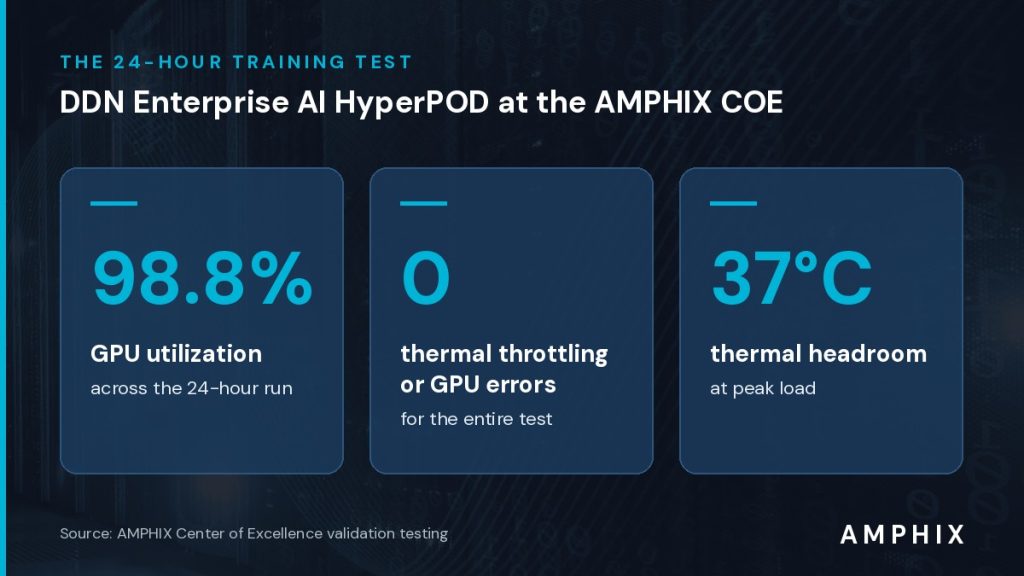
The numbers are useful, but the bigger point is what the testing represents.
We're not just benchmarking individual components. We're validating how the complete infrastructure stack performs together, including compute, storage, networking, energy, cooling, and orchestration, under sustained AI workloads.
Customers need a way to evaluate infrastructure before committing to production. Instead of relying entirely on specifications, architecture diagrams, or individual component benchmarks, they can bring their own workloads into an environment designed for validation. That creates a much clearer path to understanding whether the complete infrastructure can support what they actually need to run.
And importantly, we've now built and tested that integrated HyperPOD environment at AMPHIX, creating a foundation for customer POCs. Organizations can evaluate their own workloads, validate the configuration against their requirements, and make more informed decisions before committing to production deployment.
That is ultimately what we see as the larger opportunity for AMPHIX. The goal is not to create one successful deployment. It is to establish a repeatable path that can be used across locations and workloads.
Strata Expanse provides the physical foundation. DDN, Supermicro, and NVIDIA contribute the ecosystem technology, RAVEL provides the orchestration and operational layer.
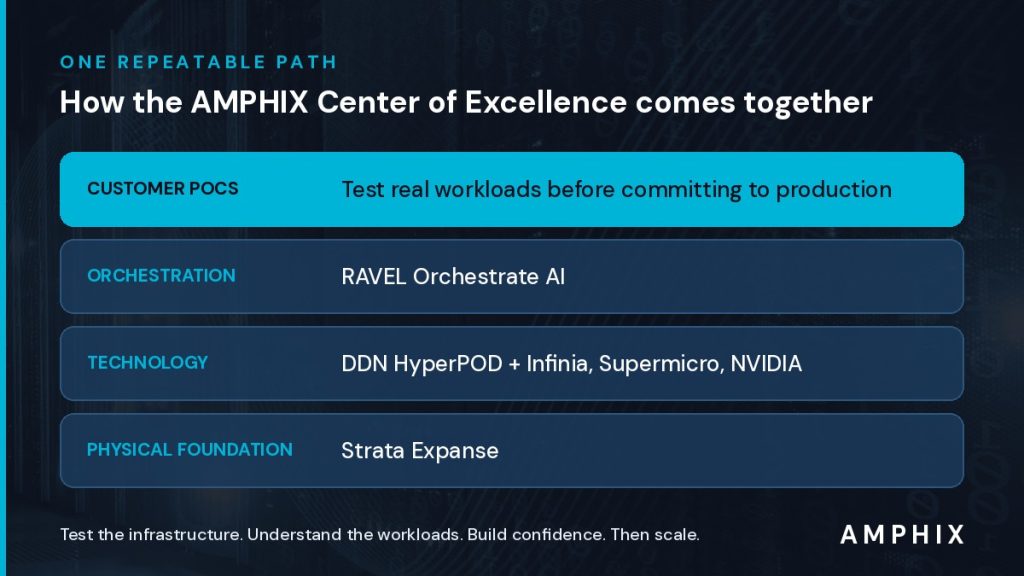
AMPHIX brings those capabilities together into an environment where integrated solutions can be developed, validated, and made available for organizations to test before moving into production. And once proven, those solutions provide a blueprint that can be replicated and scaled across future deployments.
For me, the most important part of this work is the reduction of uncertainty.
AI infrastructure decisions are expensive, and organizations are making decisions about compute, data, power, facilities, networking, and software while AI workloads continue to evolve. They need a way to test those decisions before scaling them.
That is what the AMPHIX Centers of Excellence can provide.
At AMPHIX, the objective is to give organizations a place to test their workloads, validate the configuration, understand how the infrastructure behaves, and build confidence before moving into production.
Rather than starting from scratch, organizations can start with an integrated, validated solution, test it against their specific requirements, and build on a proven foundation for production.
At RAVEL, we believe the path from AI experimentation to production starts with validation.
Test the infrastructure. Understand the workloads. Build confidence. Then scale.